

What Welding Certification Do I Need? A Guide for Welders Taking the Next Step
Every week, we get phone calls from welders who are ready to take the next step.
Sometimes the call sounds like this:
“Hey, I need to get certified so I can get a better welding job. Can I come in and get a cert?”
Or sometimes:
“I want to start doing work on my own. What certification do I need?”
And honestly? We love those calls.
Because that usually means someone is thinking bigger. Maybe they want a better-paying job. Maybe they’ve been welding for years, but their company always handled the paperwork. Maybe they’re thinking about taking side work, bidding small jobs, or eventually building their own welding business.
That is exciting.
But before we can point someone toward the right weld test, we usually have to pause and explain one important thing:
There is no such thing as one welding certification that covers everything.
“I Just Need Any Welding Certification”
Let’s imagine a welder named Mike calls us.
Mike has been welding for several years. He’s worked in shops, done repair work, and helped on field jobs. He knows how to weld. He’s not brand new.
But now he wants to apply for better jobs, and he keeps seeing postings that say things like:
- “Must be certified”
- “AWS certification preferred”
- “Stick certification required”
- “Structural welding experience needed”
- “Pipe welding certification a plus”
So Mike calls and says:
“I just need any certification so I can start applying.”
That makes sense from his side. The job postings make it sound like “certified welder” is one general thing.
But in the welding world, certifications are more specific than that.
A welding certification is not just a badge that says, “This person can weld.”
It usually says something more like:
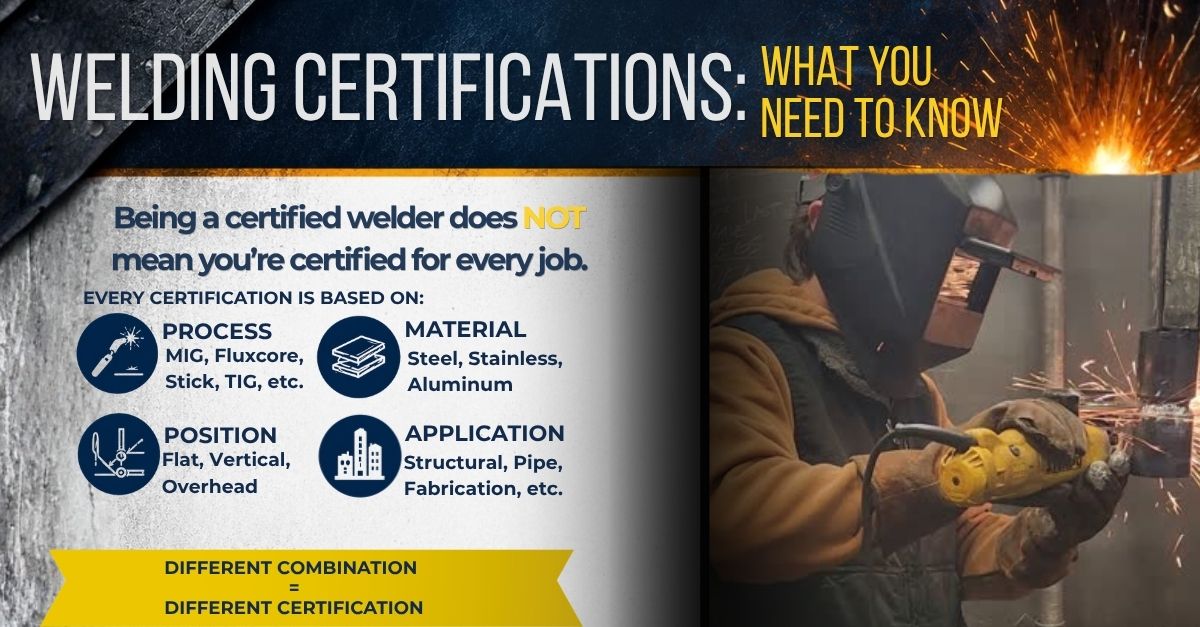
This welder successfully passed this specific test, using this process, on this material, in this position, under this code or standard.
That is why one certification may help with one job but may not apply to another.
What a Welding Certification Is Usually Based On
When we help someone figure out what test they need, we usually start by narrowing down a few key things.
1. What welding process do you need?
A certification is usually tied to a process, such as:
- Stick welding
- MIG welding
- Flux-core welding
- TIG welding
So if a job requires stick welding, a TIG certification may not help. If a company needs flux-core structural welders, a MIG test may not be the right fit.
2. What material are you welding?
Certifications can also depend on the material.
For example:
- Carbon steel
- Stainless steel
- Aluminum
A welder may be qualified for one material but not another. This matters a lot when companies are working under specific codes, job specs, or customer requirements.
3. What position are you welding in?
Position matters too.
A flat weld is not the same as an overhead weld. A vertical weld is not the same as a pipe weld.
Some jobs require welders to prove they can weld in more difficult positions because that is what the actual work demands.
4. What kind of work are you trying to do?
This is one of the biggest questions.
Are you trying to qualify for:
- Structural welding?
- Pipe welding?
- Fabrication work?
- Repair work?
- Field welding?
- Shop production?
- A specific contractor or employer requirement?
The answer changes what certification may make the most sense.
Why This Gets Confusing for Welders
A lot of welders have been certified before, but they may not have been the one managing the certification.
Their company scheduled the test.
Their supervisor told them what to weld.
Someone else handled the paperwork.
The welder just showed up and did the work.
So when that welder decides to move jobs, apply somewhere new, or start taking control of their own future, it can feel confusing fast.
That does not mean they are inexperienced.
It does not mean they are behind.
It just means they have not had to manage the certification side before.
And that is exactly where we can help.
The Better Question to Ask
Instead of asking:
“What certification should I get?”
A better starting point is:
“What kind of work am I trying to qualify for?”
Or:
“What does the job, customer, contractor, or code require?”
Once we know that, we can help narrow the path.
For example, a welder applying for a structural steel job may need a different test than someone trying to qualify for stainless TIG work. A welder wanting to do pipe work may need something different than someone trying to get into shop fabrication.
The goal is not to collect random certifications.
The goal is to get the right certification for the work you actually want to do.
Thinking About Starting Your Own Welding Business?
This is where certifications become even more important.
If your long-term goal is to take on your own welding jobs, you may eventually need to understand more than just how to pass a weld test.
You may need to understand:
- What your customer is asking for
- What code or standard applies
- What paperwork may be required
- What procedure the weld is being made under
- Whether your current qualification actually covers the job
That can feel overwhelming at first, but you do not have to know everything on day one.
The first step is simply learning how certifications work and asking better questions before you spend money on a test.
Before You Schedule a Weld Test, Know This
If you call and say, “I need to get certified,” we are probably going to ask a few questions before we schedule anything.
Not because we are trying to slow you down.
Because we want to help you avoid wasting time and money on a certification that may not help you reach your actual goal.
A few helpful things to know before calling:
- What job or type of work are you trying to qualify for?
- Did the employer give you a specific test requirement?
- What process do they need?
- What material will you be welding?
- Is it plate, pipe, structural, stainless, aluminum, or something else?
- Do they mention AWS, ASME, API, or another code?
- Do they require a certain position?
Do not worry if you do not know all the answers yet. Most people do not.
That is part of the conversation.
We’re Here to Help You Figure Out the Right Next Step
At Calumet Welding Center, we like working with welders who are trying to move forward.
Whether you are applying for a better job, trying to understand your certifications for the first time, or quietly planning a future where you run your own welding business, we want you to understand what you are getting and why it matters.
You do not need “any certification.”
You need the certification that matches your goal.
And if you are not sure what that is yet, that is okay.
Start with the work you want to do, and we can help you narrow it down from there.